 Haramain Companion
The Mīqāt for ʿUmra: where you begin Iḥrām
The Mīqāt is the place where you begin Iḥrām for ʿUmra or Ḥajj. Whoever intends Ḥajj or ʿUmra may only cross it in Iḥrām. The Prophet ﷺ set five such places. That is why anyone flying from Europe to Jeddah enters Iḥrām already on the plane, before it flies over the Mīqāt on its route.
Last updated: November 2026
What the Mīqāt is
The word means a fixed boundary. Al-Mawsūʿa al-Fiqhiyya distinguishes two kinds: a temporal Mīqāt (Mīqāt Zamānī) and a spatial Mīqāt (Mīqāt Makānī). This page is about the spatial one, that is, the places where Iḥrām begins.
For ʿUmra, it is one of the obligations (Wājibāt) of Iḥrām to enter it from the Mīqāt and to avoid the prohibitions of Iḥrām. As evidence, the Mawsūʿa cites the Sunnah and consensus (Ijmāʿ). An-Nawawī said: when the Āfāqī, that is, someone coming from beyond the Mīqāt, reaches the Mīqāt intending Ḥajj, ʿUmra or Qirān, it is forbidden for him by unanimous agreement to cross it without Iḥrām.
al-Mawsūʿa al-Fiqhiyya, entry ʿUmra, §§ 14 to 18
The basic rule
The hadith of Ibn ʿAbbās says: "The Messenger of Allah ﷺ set the Mīqāts … They are for their people and for all others who come through them intending Ḥajj and ʿUmra." Three points follow from this, which Ibn ʿUthaymīn sets out in his book:
- Each Mīqāt applies to its own people and to all others who come through it.
- Whoever's route passes to the right or left of the Mīqāts enters Iḥrām when level with the Mīqāt nearest to them.
- Whoever lives closer to Makkah than the Mīqāts, their Mīqāt is where they are.
Bukhārī, Muslim (hadith of Ibn ʿAbbās) · Ibn ʿUthaymīn, Manāsik al-Ḥajj wal-ʿUmra, ch. 3, p. 26 to 28
The five Mīqāt places at a glance
The table shows each place with its present-day name, who it applies to and where it lies. The distances are approximate. The book itself gives them in days of travel (Marāḥil).
| Mīqāt | For whom | Location and distance |
|---|---|---|
| Dhul-Hulayfaذو الحليفة today: Abyār ʿAlī |
The people of Madinah and all others who come through this Mīqāt | ≈ 420 to 450 km from Makkah, on the south-western edge of Madinah. The Mīqāt furthest from Makkah. |
| Al-Juḥfaالجحفة today: Iḥrām from Rābigh |
The people of ash-Shām and all others who come through this Mīqāt, if they have not already come through Dhul-Hulayfa. According to the app's data, the Mīqāt of most Europeans. | ≈ 200 km north-west of Makkah, on the west coast |
| Qarn al-Manāzilقرن المنازل today: As-Sayl al-Kabīr |
The people of Najd (e.g. Riyadh) and all others who come through this Mīqāt | ≈ 80 km east of Makkah, a mountain pass on the route to Taif |
| Yalamlamيلملم today: As-Saʿdiyah |
The people of Yemen and all others who come through this Mīqāt | ≈ 100 km south of Makkah |
| Dhāt ʿIrqذات عرق today: Aḍ-Ḍarībah |
The people of Iraq and all others who come through this Mīqāt | ≈ 85 to 95 km north-east of Makkah |
Ibn ʿUthaymīn, Manāsik al-Ḥajj wal-ʿUmra, ch. 3, p. 26 to 27 · Dhāt ʿIrq: hadith of ʿĀʾisha (Abū Dāwūd, Nasāʾī)
Al-Mawsūʿa al-Fiqhiyya assigns Yalamlam to the people of Yemen, Tihāma and India, and Dhāt ʿIrq to the people of Iraq and the other people of the East. On al-Juḥfa, it writes that the people of Shām, Egypt and the Maghreb today enter Iḥrām from Rābigh.
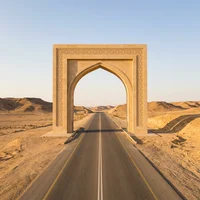

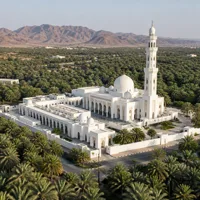
Illustrative images from the app, not photographs of the Mīqāt places.
The Mīqāt from Europe
In the app's data, al-Juḥfa is the Mīqāt for most pilgrims from Europe. Al-Juḥfa is an old, ruined village, which is why people today enter Iḥrām from Rābigh. Most pilgrims from ash-Shām, Egypt, the Maghreb and Europe, however, fly to Jeddah. They enter Iḥrām on the plane, before it flies over the Mīqāt on its route.
A special case is a stopover in Madinah. Whoever comes through Dhul-Hulayfa first must enter Iḥrām there, even if al-Juḥfa would actually be their Mīqāt. The book gives the example of an Egyptian travelling with a stopover in Madinah: he enters Iḥrām at Dhul-Hulayfa. Whoever sets out from Madinah can put on the Iḥrām garments at the hotel. Iḥrām itself, however, only begins with the Niyya at the Mīqāt.
Ibn ʿUthaymīn, Manāsik al-Ḥajj wal-ʿUmra, ch. 3, p. 26 to 27
Iḥrām on the plane
Ibn ʿUthaymīn calls the plane the most critical situation: it flies over the Mīqāt quickly and leaves no opportunity. That is why much is done in advance.
-
Before departure
The book says: when boarding the plane. In practice, this can be done at home or at the airport. Ghusl, as one performs it for Janāba. Men perfume the head and beard. Cut nails and hair beforehand, because this is no longer allowed in Iḥrām.
-
Putting on the Iḥrām garments
Put on the Iḥrām garments before the plane is level with the Mīqāt. On transit stops you can wear them under your normal clothes and take the normal clothes off in the toilet in good time.
-
Listening for the announcement
Some airlines announce on Makkah routes that the Mīqāt is being passed, and some planes show it as a separate marker on the in-flight map.
-
Making the Niyya and saying the Talbiya
Shortly before the Mīqāt and not only exactly when level with it, because the plane passes over it quickly. Whoever enters Iḥrām earlier out of caution does nothing wrong. About 30 minutes before landing in Jeddah is often mentioned. Depending on the flight route, however, the Mīqāt may be passed earlier, so if in doubt, it is better to do it well in advance.
Ibn ʿUthaymīn, Manāsik al-Ḥajj wal-ʿUmra, ch. 3, p. 28 and ch. 9, p. 113
The typical mistake. Some people fly over the Mīqāt, put off Iḥrām and only enter it at Jeddah airport. Ibn ʿUthaymīn says about this: it goes against the command of the Prophet ﷺ and is a transgression of the limits set by Allah.
Ibn ʿUthaymīn, Manāsik al-Ḥajj wal-ʿUmra, ch. 9, p. 113 to 114
Travelling via Jeddah: the differences
Jeddah is not a Mīqāt for someone arriving from outside. Whoever flies to Jeddah enters Iḥrām before the Mīqāt on their flight route, usually on board. Even so, Jeddah appears in the data as a place of Iḥrām in three cases:
- You live in Jeddah or are staying there
- Whoever is closer to Makkah than the Mīqāts enters Iḥrām from where they are. This applies to residents of Jeddah, to expatriates who live there and to visitors who only decide on ʿUmra or Ḥajj once there. There is no need to travel back to Dhul-Hulayfa or al-Juḥfa.
- You arrive without intending ʿUmra
- The Mīqāts apply to whoever intends Ḥajj and ʿUmra. Someone who travels to Jeddah on business, for example, and has already fulfilled their obligation does not have to enter Iḥrām. If they decide to after all, they enter Iḥrām from the place where they made that decision. According to the book, it is better not to skip Iḥrām at the Mīqāt, in order to gain the reward and to avoid the difference of opinion.
- Your route passes no Mīqāt
- Whoever does not pass level with any Mīqāt on their route, such as the people of Sawākin in Sudan travelling by sea, enters Iḥrām from Jeddah according to the book.
Ibn ʿUthaymīn, Manāsik al-Ḥajj wal-ʿUmra, ch. 3, p. 26 to 29 and ch. 9, p. 112 to 113
Where the schools differ
For the Mīqātī, that is, someone who lives within the areas of the Mawāqīt, level with them or closer to Makkah, the Mīqāt is where he begins the ʿUmra. In detail, the madhāhib differ:
- Ḥanafiyya: His Mīqāt is the whole of the Ḥill.
- Mālikiyya: He enters Iḥrām from his house or his mosque, and nowhere else.
- Shāfiʿiyya and Ḥanābila: His Mīqāt is the settlement in which he lives; he may not leave it without Iḥrām.
Whoever is in Makkah or in the Ḥaram goes out to the Ḥill for ʿUmra, even if only by a single step. Well known places are Tanʿīm and Jiʿrāna.
al-Mawsūʿa al-Fiqhiyya, entry ʿUmra, §§ 17 and 18
Crossed the Mīqāt without Iḥrām: what applies now
Return to the Mīqāt you flew over and enter Iḥrām there. Whoever does not do so and enters Iḥrām in Jeddah owes, according to most scholars, a Fidya, which is slaughtered in Makkah and distributed entirely to the poor there.
- Returning: in practice, by car or bus back to the Mīqāt, then enter Iḥrām there. This applies as long as you have not yet entered Iḥrām. If you have already entered it after the Mīqāt, the blood sacrifice lapses according to the Ḥanafīs and Shāfiʿīs if you return to the Mīqāt before beginning an act such as the Ṭawāf; according to the Mālikīs and Ḥanbalīs, it remains due.
- Type of Fidya: Entering Iḥrām from the Mīqāt is one of the obligations (Wājibāt). Whoever leaves one of them out owes, according to the majority of scholars, a sheep, or a seventh of a camel, or a seventh of a cow.
- Distribution: He does not eat from it and does not give any of it to a wealthy person, because it counts as an expiation (Kaffāra).
Al-Mawsūʿa al-Fiqhiyya also states in general terms: whoever leaves out a Wājib in ʿUmra commits a sin by doing so, and a blood sacrifice (Dam) becomes obligatory for him. Which acts count as Wājib, however, is not the same everywhere across the schools.
And if it happened out of forgetfulness? Ibn ʿUthaymīn's book does not treat this case at the Mīqāt separately and does not distinguish here between intention and forgetfulness. According to most scholars, forgetfulness does not remove the blood sacrifice if one does not return. As soon as you notice, return to the Mīqāt. If in doubt, ask a scholar.
Ibn ʿUthaymīn, Manāsik al-Ḥajj wal-ʿUmra, ch. 9, p. 114 · al-Mawsūʿa al-Fiqhiyya, entry ʿUmra, § 36
Practical preparation
For travel by car or bus, the book describes this order:
Stop at the Mīqāt if your route passes through it, otherwise at the point level with it. The Mīqāt mosques often have changing rooms and washrooms. Allow about 30 to 45 minutes.
Ghusl, as one performs it for Janāba, then perfume on the head and beard.
Put on the Iḥrām garments. Men: Izār and Ridāʾ. Women: clothing of their choice, without displaying adornment, without a niqāb and without gloves.
Pray the obligatory prayer if it is its time, otherwise two rakʿas with the intention of the Sunnat al-Wuḍūʾ. Women who are menstruating or in postnatal bleeding do not pray.
After the prayer, make the Niyya and say the Talbiya: men aloud, women do not raise their voices. Enter Iḥrām before you leave the Mīqāt.
There is a difference in the reasoning for the two rakʿas: Ibn ʿUthaymīn calls them rakʿas with the intention of the Sunnat al-Wuḍūʾ, while al-Mawsūʿa al-Fiqhiyya speaks of two rakʿas as the Sunnah of Iḥrām, which the obligatory prayer replaces.
Ibn ʿUthaymīn, Manāsik al-Ḥajj wal-ʿUmra, ch. 9, p. 112 · al-Mawsūʿa al-Fiqhiyya, entry ʿUmra, § 7
Which things are forbidden in Iḥrām after that is on the page Iḥrām prohibitions. The whole sequence after the Mīqāt is shown in ʿUmra step by step, and the supplications are under Duʿāʾ for ʿUmra.
In the app: With "ʿUmra as a path", Haramain Companion guides you through eight stations from the Mīqāt to completion, with images, book references and common mistakes. The steps remain available offline, so on the plane too. Play Store · App Store · Web app
Frequently asked questions
- What is the Mīqāt?
- The Mīqāt is the place where you begin Iḥrām for ʿUmra or Ḥajj. Whoever intends Ḥajj or ʿUmra may only cross it in Iḥrām.
- Which Mīqāt applies to pilgrims from Europe?
- For most pilgrims from Europe it is al-Juḥfa; today Iḥrām is entered from Rābigh. Whoever travels with a stopover in Madinah enters Iḥrām at Dhul-Hulayfa.
- Is Jeddah a Mīqāt?
- No. Jeddah is not a Mīqāt for someone arriving from outside. Whoever flies to Jeddah enters Iḥrām before the Mīqāt on their flight route, usually on board.
- When do I enter Iḥrām on the plane?
- Shortly before the Mīqāt and not only exactly when level with it, because the plane passes over it quickly. Whoever enters Iḥrām earlier out of caution does nothing wrong.
- What should I do if I flew over the Mīqāt without Iḥrām?
- Return to the Mīqāt you flew over and enter Iḥrām there. Whoever does not do so and enters Iḥrām in Jeddah owes, according to most scholars, a Fidya, which is slaughtered in Makkah and distributed entirely to the poor there.
Further reading
- ʿUmra step by step
- What is forbidden in Iḥrām
- Common mistakes in ʿUmra
- ʿUmra for women (German)
- Ḥajj step by step (German)
- Visiting Madinah (German)
- Duʿāʾ for ʿUmra
- Umrah guide · German original: Der Mīqāt für die ʿUmra
Don't miss the Mīqāt: take the app on board
Haramain Companion accompanies you from the Mīqāt to cutting your hair: eight stations with book references, fiqh with sources and the four schools, plus a Ṭawāf and Saʿy counter. Maps, duʿāʾ and steps also work offline. Free, in 14 languages.
Get it on Google Play Download on the App Store Open in browserLast updated: November 2026. This page reflects the content of the app (Ibn ʿUthaymīn, Manāsik al-Ḥajj wal-ʿUmra, and al-Mawsūʿa al-Fiqhiyya). It does not replace personal advice: if you are unsure, ask a scholar.